
CONTROLLED IN-SITU PARTICLE FORMATION
Fluid during placement.
Particles after arrival.
DISE-HP is a proposed aqueous continuous-phase reactive droplet suspension. It is designed for ≤10 cP placement at up to 150°C and 10,000 psi, followed by thermally delayed, strictly intra-droplet suspension polymerisation within a 25–75 minute target window. The qualification objective is a discrete 70–600 µm particle population that supports a permeable pack under up to 6,000 psi closure stress.
PLACEMENT LIMIT
≤10 cP
TARGET LATENCY
25–75 min
PARTICLE ENVELOPE
70–600 µm
CLOSURE QUALIFICATION
6,000 psi
Evidence status: ExxonMobil challenge requirements and DISE engineering targets pending integrated HPHT validation; not reported as achieved results.
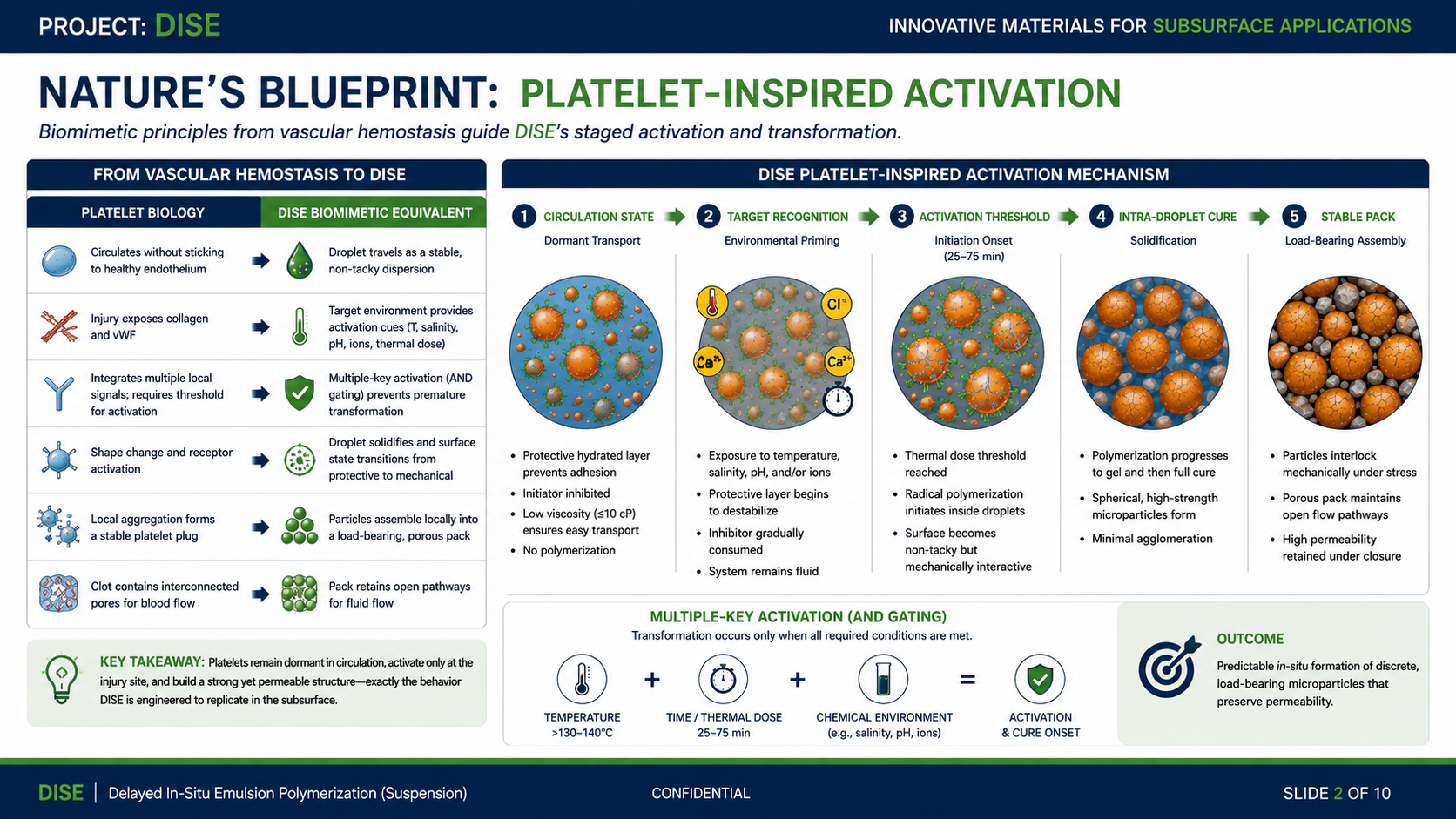
Delivery and function are separated in time.
The complete reactive droplet suspension is intended to remain within the ≤10 cP placement limit while travelling through pumps and the near-wellbore region. A programmed 25–75 minute thermal-dose induction window then initiates polymerisation strictly inside stabilised droplets. The continuous carrier remains liquid: the design objective is zero connected bulk-gel matrix and a discrete, proppant-like particle pack with open interstitial flow paths.
Transport → stable, pumpable precursor
Delay → controlled activation window
Transform → confined particle formation
BIOMIMETIC DESIGN LOGIC
From haemostasis to restored flow
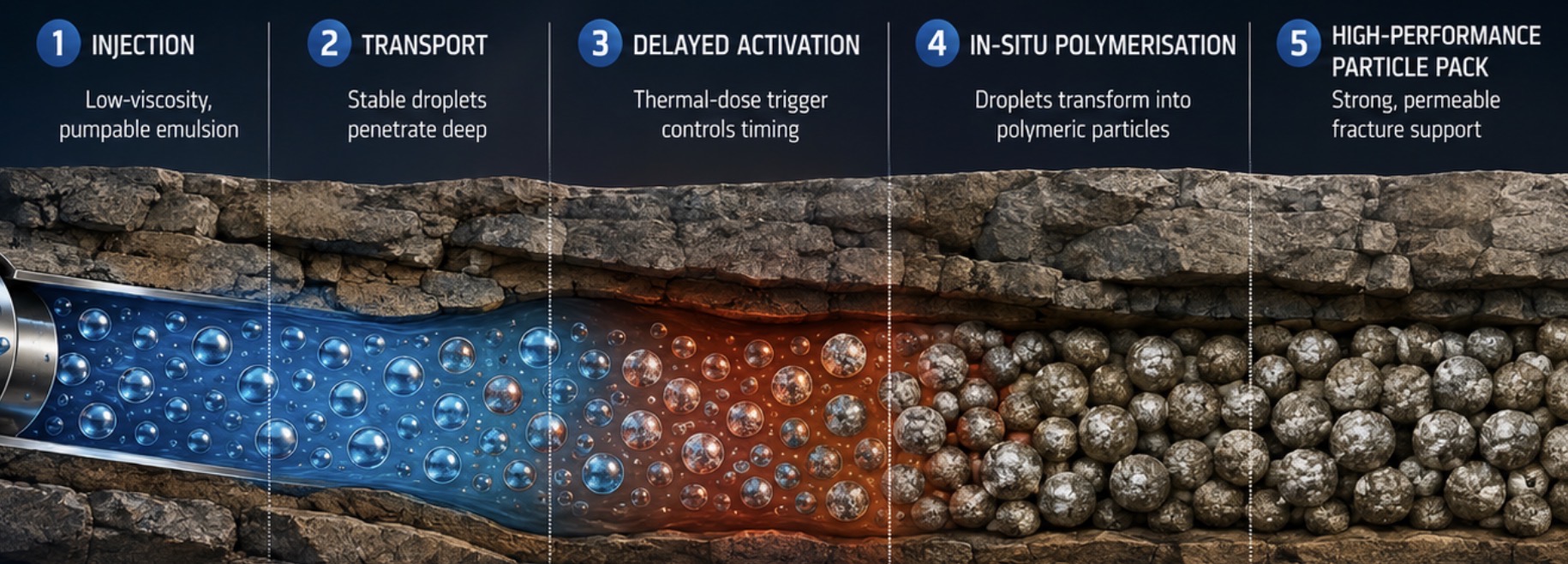
DISE was conceived through a clinician’s lens: reinforcement is valuable only when it does not permanently obstruct the pathway it is intended to protect.

DISE takes functional inspiration from haemostasis and vascular recanalisation. Platelets circulate freely until injury localises their response; aggregation and fibrin then provide temporary mechanical stability. As healing progresses, fibrinolysis and recanalisation restore pathways for blood flow.
DISE follows a comparable engineering sequence. Reactive droplets are designed to remain mobile during transport, localise within the fracture and convert—after a controlled delay—into mechanically resistant particles. The intended outcome is not a continuous polymer plug, but a discrete particle assembly with interconnected interstitial spaces through which fluid can continue to flow.
Core principle: structural reinforcement without permanent blockage.
FUNCTIONAL SEQUENCE

01 · TRANSPORT
Droplets remain mobile in the carrier.
02 · LOCALISATION
The fluid reaches the target fracture.
03 · REINFORCEMENT
Delayed intra-droplet polymerisation forms particles.
04 · PRESERVED FLOW
Interstitial pathways remain the design objective.
Scientific boundary: this is a functional biomimicry analogy. DISE does not reproduce coagulation biology, and preservation of fracture conductivity remains a qualification target requiring integrated HPHT validation.
DELIVERY & QUALIFICATION
From placement to proof
DISE separates field placement from laboratory qualification. Every stage has a defined operating question, measurable output and stop/go criterion before the integrated platform advances beyond TRL 3.

01 · DELIVERY & INJECTIVITY
Release only when the fluid is placement-ready
Surface preparation, inline droplet formation and late activation dosing are treated as controlled operations. Pump release depends on viscosity, droplet distribution, stability and available induction-time margin—not assumption.
- Confirm complete-fluid viscosity within the ≤10 cP challenge ceiling.
- Check droplet stability after representative mixing and shear.
- Track surface residence time and thermal-dose exposure.
- Define hold, stop, isolate and flush responses.
02 · EXPERIMENTAL VALIDATION
Prove the complete sequence under representative conditions
The programme progresses from formulation screening to HPHT kinetics, dynamic transport, particle characterisation and stressed-flow testing. Success requires simultaneous compliance; passing one isolated test is not sufficient.
- HP-DSC or rheokinetic confirmation of the induction window.
- Dynamic shear and thermal-history survival without line fouling.
- Discrete-particle morphology with no connected gel phase.
- Crush, fines and retained conductivity under closure stress.
CHALLENGE REQUIREMENT
≤10 cP
Complete-fluid placement viscosity
DISE DESIGN TARGET
25–75 min
Thermal-dose induction window
DISE DESIGN TARGET
70–600 µm
Discrete particle population
VALIDATION PENDING
Up to 6,000 psi
Closure-stress qualification
Evidence status: these figures are challenge thresholds or DISE qualification targets. They are not presented as completed integrated-system results.
TRL 3 · CURRENT
Integrated proof of concept
Analytical kinetics, suspension rheology and packed-bed models define falsifiable system-level hypotheses supported by component precedent.
TRL 4 · NEXT
Laboratory validation
Confirm ≤10 cP rheology, the 25–75 minute delay and discrete 70–600 µm particle formation in integrated HPHT batch tests.
TRL 5
Relevant-environment validation
Demonstrate dynamic transport at up to 10,000 psi and 150°C without premature cure, line fouling or loss of morphology.
QUALIFICATION GATE
Fracture conductivity
Measure crush, fines and retained flow through the particle pack under up to 6,000 psi closure stress.

